Signs of foundation problems and which cracks matter
Most houses crack a little. This guide separates ordinary settling from the patterns that point to real movement, and shows how to track a crack before you call anyone.
What the crack is telling you
| What you see | What it often means | Worth a closer look when |
|---|---|---|
| Hairline vertical crack in drywall or paint | Drying and normal settling | It is wider than about a quarter inch, grows, or appears with sticking doors |
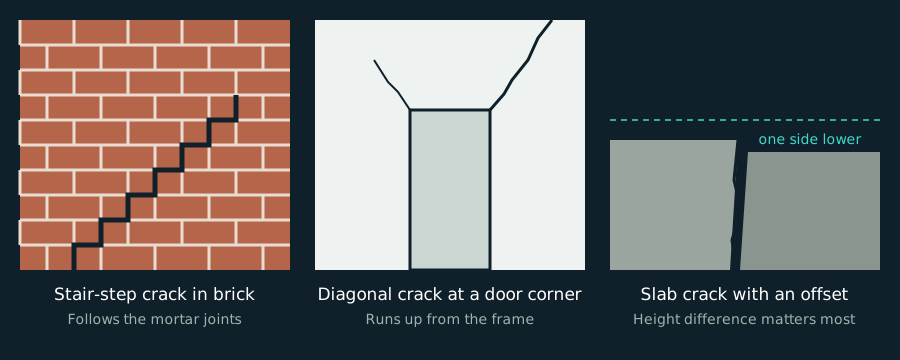
| Diagonal crack from a door or window corner | Stress at the weakest point of the wall | It lengthens or shows up in several rooms |
| Stair-step crack in brick | Wall following movement in the foundation | It widens toward the top or bottom, or brick pulls away from a frame |
| Horizontal crack in a block or foundation wall | Pressure from soil or water against the wall | Always. Call soon. |
| Crack in a garage slab or patio | Shrinkage cracks are common in concrete | One side sits higher than the other |
| Gap between wall and ceiling or floor | Seasonal movement | It stays after the weather changes |
The quarter inch figure is a rule of thumb, not a diagnosis. Only an inspection can tell you what is happening in your home.
How to track a crack
- Photograph itPut a coin or ruler next to the crack so size is clear. Date the photo.
- Mark the endsDraw a pencil line across each end and write the date.
- Measure monthlyRecord the width in the same spot each time.
- Compare across seasonsCracks that open in dry months and close in wet ones are moving with the soil.
Check these first
- Gutters and downspouts: are they clear, and do they empty away from the house?
- Grading: does the ground slope away from the slab?
- Water meter: with everything off, is it still moving?
- Trees: is a large one growing within a few feet of the wall that is cracking?
When to call sooner
Call soon if cracks are widening quickly, a door suddenly will not close after a storm, water is coming in, or you see a horizontal crack in a foundation wall. Mention anything that changed recently when you request an inspection.
Three crack patterns, side by side
Signs inside the house
Cracks are only part of the picture. Doors that stick or will not latch, windows that are hard to open, gaps between the top of a wall and the ceiling, and floors that feel like they slope are all worth noting. Many of these come and go with the seasons on clay soil. Write down when you notice each one, so you can show a pattern rather than a single moment.
Signs outside the house
Walk the outside of the house slowly. Look for brick pulling away from window frames, gaps where trim meets brick, a slab edge that looks exposed or tilted, and soil that has pulled away from the foundation in dry weather. Check the garage floor and driveway too, and note any section that sits higher than the one beside it.
What is usually not a foundation problem
Thin cracks in new drywall, small cracks in a garage floor with no height difference, and a single sticking door during a humid week are common and often harmless. Keep watching them, but they rarely need a repair on their own.
Help in your town
Read what the ground is like and what homeowners ask in San Marcos, New Braunfels, Converse, Live Oak and Universal City, or see the full service area.
How the inspection works
- Send a request or callFill in the short form or call (726) 610-5892. Tell us your town and what you are seeing.
- A company contacts youA local foundation repair company calls to set a time that works for you.
- The visitThe inspector measures floor levels, looks at cracks, doors and drainage, and checks the crawl space if there is one.
- Written findingsYou should get the findings and any repair plan in writing, so you can compare it with other quotes.
Last updated October 2026.
Request an inspection
Tell us what you are seeing. A local foundation repair company will contact you to schedule a visit.
Prefer to talk? Call (726) 610-5892.
Most companies offer a free inspection. Confirm when you book.
Common questions
Are new house cracks normal?
Hairline cracks in the first year or two are common as materials dry out. Check your builder warranty before hiring outside help for a new home.
Can I just patch the crack?
Patching hides a crack but does not stop what caused it. If the crack reopens, track it and have it looked at.
Do cracks change with the seasons here?
Often, yes. Much of the area sits on clay that swells when wet and shrinks when dry, so cracks may open in a dry summer and close after rain. Tracking them over a few months shows the pattern.
Ready to have someone look at it?
Tell us what you are seeing. It takes about a minute, and photos are optional.