Slab foundation repair between Austin and San Antonio
Most newer homes in the area sit on a concrete slab poured on the ground. When the soil under it moves, the slab cracks, tilts or drops at one edge. Here is how the repair is done and what to ask.
How slabs get into trouble
A slab is only as steady as the soil under it. In this area the usual causes are clay that swells and shrinks, water collecting at the edges, trees pulling moisture from one side, and leaks in pipes under the slab. Movement is rarely even. One corner drops, the middle heaves, or an edge pulls away.
Common repair methods
Pressed steel piers
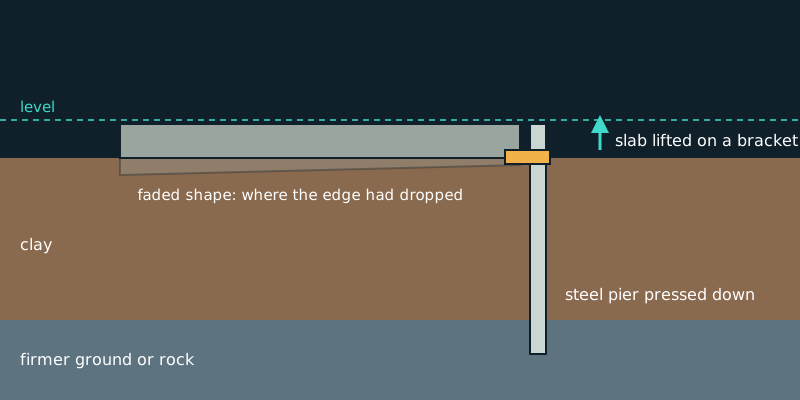
Steel sections are hydraulically pressed into the ground beside the slab until they reach firm soil or rock. The slab is then lifted and held on the piers. This is one of the most common methods for settlement along the perimeter.
Drilled concrete piers
Holes are drilled below the slab edge, filled with steel and concrete, and used to carry the house. Companies use them where deeper or higher capacity support is needed.
Helical piers
Steel shafts with spiral plates are screwed into the ground. They suit heavier loads and tight access, and they usually cost more per pier.
Foam or grout injection
Polyurethane foam or cement grout is injected under the slab to fill voids and lift sections. It fits smaller settlement, garage floors and patios better than a whole-house lift.
Some companies sell their own named pier systems. Whatever the brand, ask for the pier type, how deep it will go and how many are planned.
Post-tension slabs
Many Texas slabs have steel cables inside the concrete that are pulled tight when the slab is poured. Drilling or cutting into one without locating the cables can be dangerous and can damage the slab. Ask whether yours has them and how the company will find them before it digs or drills.
What the job looks like
- Inspection and measurementsThe company records floor elevations across the house and notes cracks, door gaps and drainage.
- A written planIt should show where each pier goes, the pier type and how the lift will be done.
- Excavation and installationCrews dig at each pier location, install the supports and lift the slab in stages.
- Testing and cleanupMany companies test plumbing lines before and after, then backfill and restore the dug areas.
Most jobs take from a day to about a week.
What the repair does not fix
A lift stabilizes the structure. It does not repair cracked drywall, brick or tile unless the quote says so. It also will not stop the problem again if water keeps collecting beside the slab, so ask how drainage will be handled.
What it costs
Pier counts and prices vary widely. See the cost guide for ranges and what moves them.
Slab or pier and beam?
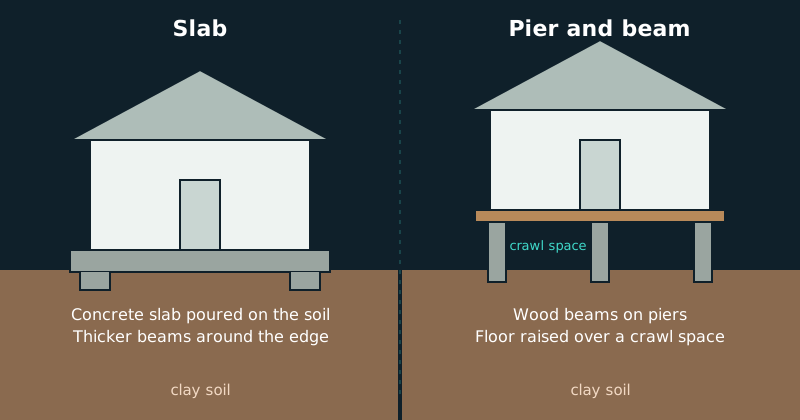
Not sure which kind of foundation you have? If your floors sit at ground level with no vents or access panel around the base of the house, it is almost certainly a slab.
Help in your town
Read what the ground is like and what homeowners ask in Kyle, Cibolo, Schertz and Selma, or see the full service area.
How the inspection works
- Send a request or callFill in the short form or call (726) 610-5892. Tell us your town and what you are seeing.
- A company contacts youA local foundation repair company calls to set a time that works for you.
- The visitThe inspector measures floor levels, looks at cracks, doors and drainage, and checks the crawl space if there is one.
- Written findingsYou should get the findings and any repair plan in writing, so you can compare it with other quotes.
Last updated October 2026.
Request an inspection
Tell us what you are seeing. A local foundation repair company will contact you to schedule a visit.
Prefer to talk? Call (726) 610-5892.
Most companies offer a free inspection. Confirm when you book.
Common questions
How many piers does a typical house need?
It depends on the size of the house and how far it moved. Published guides mention anything from a handful to a dozen or more. Ask for a pier map so you can see where each one goes.
Is foam injection as good as piers?
They solve different problems. Foam can lift and fill voids under a slab that has settled slightly. Piers carry the structure down to firmer ground. An inspector should explain which one fits your situation and why.
Will my floors be perfectly level afterward?
Perfect level is rare. Ask for before and after floor elevation readings, and ask what range the company aims for.
Ready to have someone look at it?
Tell us what you are seeing. It takes about a minute, and photos are optional.